
Your First Hour in Idyll: Everything Aniimo Teaches You, in Order
Aniimo front-loads its teaching into 22 short practice rooms and a stream of one-time prompts, then never repeats itself. Here is that whole curriculum in order, including the rules it shows you once and the ones it never mentions at all.
Aniimo teaches you almost everything it intends to teach in your first hour, and it does it twice over: once in 22 purpose-built practice rooms, each drilling exactly one mechanic, and once through single-use prompts that fire the first time you touch something new out in the world. Miss a prompt and it does not come back. This page is that whole curriculum, in the order the game runs it, with the game’s own wording where its phrasing is the clearest thing anyone has written.

The framing: you are joining an institute
The game opens by making you staff, not a wanderer: “Congrats on joining Polaris Institute. Adventure through Idyll, catch Aniimo, and become a stronger Pathfinder.” That framing matters later, because the Institute is also the body that certifies your Badges and hands out the Elite Training track.
1. Movement, in its own room
Two practice rooms cover nothing but moving and aiming the camera. The game is explicit that it is a lesson rather than a level: “In this course, we’ll go over the basics of character movement. Now, move your character, follow the guide and reach the Final Objective.” Nothing here is hidden later, so it is safe to rush.
2. Catching, and the part most players miss
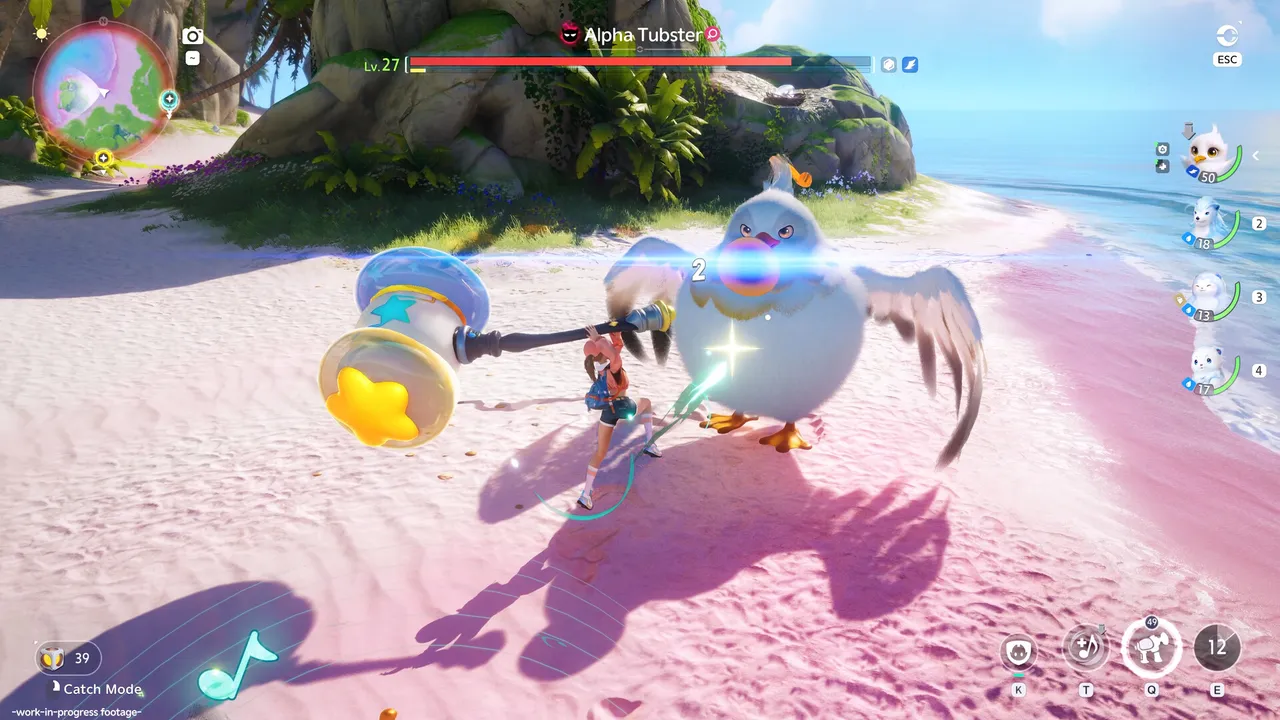
Two more rooms cover catching. The basic loop is what you would expect: aim the crosshair, throw the Aniipod. Two rules around it are worth more than the loop itself.
The first is that weakening comes before throwing: “Dealing damage and weakening the target Aniimo will increase the success rate of catching.” The second is the one the game shows once and never repeats, and it is the single most useful thing in the opening hour:
When entering the white tall grass, you will start to move in stealth and become less noticeable by Aniimo. When you approach an Aniimo from behind without being noticed, you can perform a catch using Backstab, and the success rate will be significantly increased.
White tall grass is a stealth field. Approaching unseen from behind converts into a Backstab catch at a much better rate. That is a free, repeatable advantage available from minute one, and the game mentions it exactly once.
Tier still matters on top of all that: “Aniipods of different quality have different catch success rates. Using an Aniipod Ultra guarantees a successful catch.” The full maths behind those rates lives in our catch rate formula, and the tier-by-tier breakdown is in the capture guide.
3. Elements and Break, in six rooms
Six practice rooms are elemental primers, one each for Fire, Water, Ice, Electric and Impulse, plus a general one. The rule they exist to teach is stated plainly: “There are 9 different Aniimo elements and they all counter one another.” Nine elements, a full counter ring, no neutral.
Five more rooms drill fighting. The one number to take away is what Break actually does: “When BREAK reaches zero, the target will be stunned and temporarily unable to move.” A stunned target is both easier to kill and easier to catch, which is why Break sits at the centre of most team compositions. Our combat guide covers the rest.

Command Mode is taught here too, and it does double duty: “When commanding an Aniimo to move, the Aniimo will use its unique abilities. Such as igniting vines or generating an ice wall to clear obstacles and help you proceed.” Your partner is a traversal tool as much as a weapon.
4. Pathfinding: three abilities, one slot each
Traversal is gated behind your creatures rather than behind gear: “Aniimo have three types of Pathfinding abilities: Climb, Swim, and Fly. From this menu you can assign one Aniimo per ability type so they will automatically activate that Pathfinding ability.”
So a full traversal kit is three creatures, not one. The game adds a warning about flying that is easy to learn the hard way instead: “Rising consumes Stamina. If your Stamina runs out, you’ll drop out of the sky, so be careful.”

5. Your partner, your camera, your Homeland
Three rooms cover partner features, four cover Lumin Amber and the Branch, and a long run of prompts covers the Homeland. The Homeland prompt worth writing down is the one with a number in it: “Each Aniimo consumes 10 Energy worth of food per minute. Different foods provide different amounts of Energy.” That single rate is what makes food planning matter at all; the farming guide builds on it.

The Branch prompts explain why you feed it: “Nurturing the Branch with enough Amber will improve the current area’s ecology. This will increase the Aniimo catch chance and even unlock the rare Prismana Flow.”
6. Badges, which are quietly a progression system
Badges look decorative and are not. The game describes them as a record: “Adventure Badges are a mark of honor that record a Pathfinder’s exploration achievements, training results, and chance encounters. All Badges are reviewed and certified by Polaris Institute before being awarded. Collect Badges to unlock exclusive titles and various adventure privileges.”
And they are tied to catching specifically: “Catch more species of Aniimo in the area to obtain Badges and improve the Area Badge quality, unlocking more privileges to aid exploration.” Filling out a region’s roster is not just completionism, it buys you exploration privileges in that region.
What the tutorial never tells you
The curriculum stops well short of the systems that decide how strong your team ends up. The game never explains Potential grades or how personality traits buff stats (see perfect your Aniimo), never covers Resonance beyond the word itself (see the stats guide), and never mentions Umbral, the guaranteed-Perfect rarity added at launch (see hunting Umbral). It also leaves the whole competitive layer untouched, including Egg Heist.
That gap is the honest reason a site like this one exists: the opening hour teaches you to play, not to build.